RACERT Certification for Global Compliance Standards
Table of Contents
Introduction
Compliance is no longer optional for modern organisations. Cybersecurity threats continue to evolve. Regulatory scrutiny is increasing. Customers, partners, and regulators now expect organisations to demonstrate that their systems are not only well designed, but also independently verified.
Certification is now a clear badge of trust in any area of information cybersecurity, information management, operational resilience, or quality management. This is because certification demonstrates that the organisation does not solely depend on internal assurance but is also open to assessment on universally accepted standards.
RACERT is an independent certification body based in Australia, supporting organisations locally and internationally in demonstrating conformity with globally recognised standards. Through structured audits, transparent assessments, and evidence-based decision-making, RACERT helps organisations move beyond surface-level compliance and strengthen how they operate, manage risk, and build long-term resilience.
Why Certification Matters Today
Certification is more than a certificate on a wall. It is a signal. A signal to customers, regulators, and stakeholders that an organisation has invested in disciplined systems, repeatable controls, and measurable governance.
International frameworks such as ISO/IEC 27001, ISO 22301, ISO/IEC 27701, and the Essential Eight provide structured approaches to managing risk, protecting information, and maintaining continuity during disruption. When these frameworks are independently certified, they become powerful tools for credibility and competitive advantage.
Organisations that pursue independent certification are able to:
- Demonstrate reliability and trust across borders
- Strengthen internal processes and accountability
- Gain recognition in regulated and international markets
- Reduce operational and cyber risk through structured controls
- Improve confidence with customers, partners, and regulators
Certification creates consistency. It replaces ad hoc practices with clearly defined systems that can be tested, monitored, and improved over time.
RACERT’s Core Values That Shape Every Assessment
Every certification decision carries responsibility. RACERT’s assessment methodology is built on principles that ensure outcomes are fair, consistent, and credible, regardless of industry or organisation size.
| Core Value | What It Means in Practice |
|---|---|
| Rigorous Assessment | Each audit is conducted against the exact requirements of the relevant standard or framework. |
| Accredited Integrity | Certification decisions are based solely on objective, verifiable evidence. |
| Consistent Compliance | Standardised methodologies ensure reliable outcomes across all audits. |
| Ethical Evaluation | All assessments are conducted impartially, without bias or external influence. |
| Reliable Verification | Management systems are verified through documented and observable evidence. |
| Transparent Reporting | Clear reports explain findings, nonconformities, and compliance status. |
These principles ensure certification outcomes can be trusted by regulators, customers, and global partners alike.
Standards Supported by RACERT
RACERT assesses a wide range of internationally recognised standards and frameworks that support cybersecurity, privacy, quality, resilience, and emerging governance requirements.
Supported standards include:
Together, these standards help organisations build mature systems for information security, business continuity, quality management, privacy protection, and AI governance across diverse operational environments.
Our Approach to Certification
Independence sits at the core of RACERT’s certification model. The certification process is designed to be transparent, structured, and supportive, while remaining strictly impartial. RACERT does not provide consulting or implementation services that could compromise objectivity.
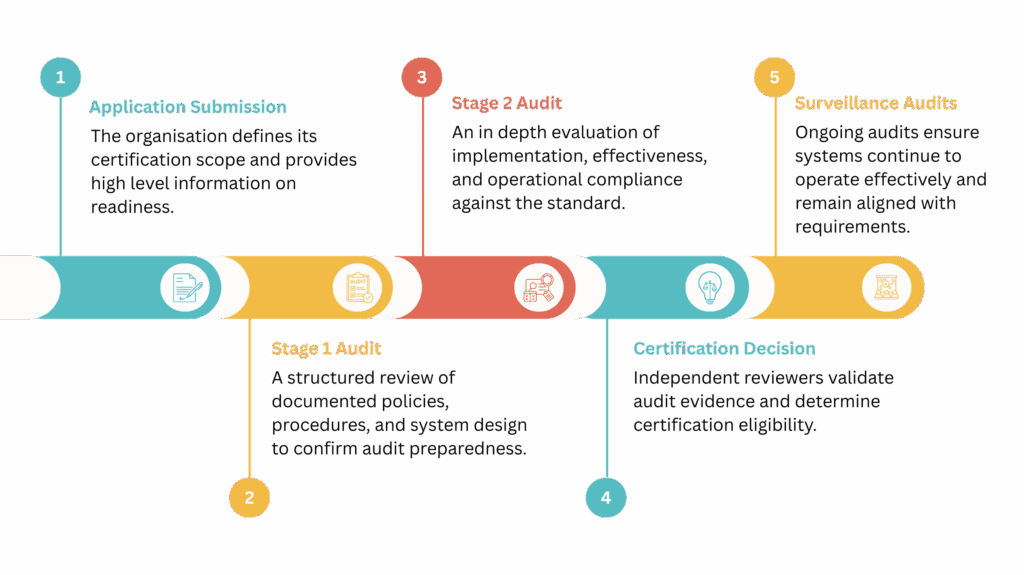
How the Certification Path Works
1. Application Submission
The organisation defines its certification scope and provides high-level information on readiness.
2. Stage 1 Audit
A structured review of documented policies, procedures, and system design to confirm audit preparedness.
3. Stage 2 Audit
An in depth evaluation of implementation, effectiveness, and operational compliance against the standard.
4. Certification Decision
Independent reviewers validate audit evidence and determine certification eligibility.
5. Surveillance Audits
Ongoing audits ensure systems continue to operate effectively and remain aligned with requirements.
This staged approach supports consistency, clarity, and confidence at every step of the certification journey.
Safeguards That Protect Certification Integrity
To maintain trust in certification outcomes, RACERT also manages a range of governance and assurance mechanisms, including:
- Formal complaints and appeals processes
- Certificate suspension and withdrawal protocols
- A verified certificate directory
- Clear guidelines for certification mark usage
These mechanisms ensure accountability and protect the value of certification for all stakeholders.
Global Reach With Local Expertise
Operating from Bella Vista, NSW, RACERT delivers certification services across Australia and supports organisations in key international markets, including the UK. This balance of global perspective and local understanding allows audits to reflect both international best practice and regional regulatory expectations.
Organisations benefit from assessments that are globally aligned, yet practically grounded in their operational and compliance context.
Why Independent Certification Matters
Independence is what gives certification its credibility. When assessments are free from conflict of interest and based on evidence alone, stakeholders can rely on the outcome.
Independent certification:
- Eliminates consulting bias
- Ensures factual and repeatable assessments
- Protects the integrity of international standards
- Demonstrates genuine organisational maturity
- Strengthens regulator and customer confidence
True assurance comes from verification, not self declaration.
How Certification Drives Operational Excellence
Beyond compliance, certification often becomes a catalyst for improvement. Standards such as ISO 9001, ISO 22301, and NIST CSF encourage organisations to refine processes, clarify responsibilities, and embed risk awareness into daily operations.
Certified organisations commonly experience:
- More efficient and consistent operations
- Stronger risk identification and treatment
- Improved documentation and accountability
- Higher customer satisfaction
- Greater resilience during disruption
Over time, these improvements translate into stronger performance and sustainable growth.
Frequently Asked Questions
Conclusion
Certification builds confidence where it matters most. It shows that systems are not only designed with intent, but tested against recognised standards and verified by an independent authority.
Through structured audits and impartial evaluation, the RACERT audit process ensures that certification decisions remain credible, evidence-driven, and globally trusted. For organisations seeking to strengthen resilience, demonstrate accountability, and operate with confidence, independent certification is no longer optional. It is essential.
Recent Post